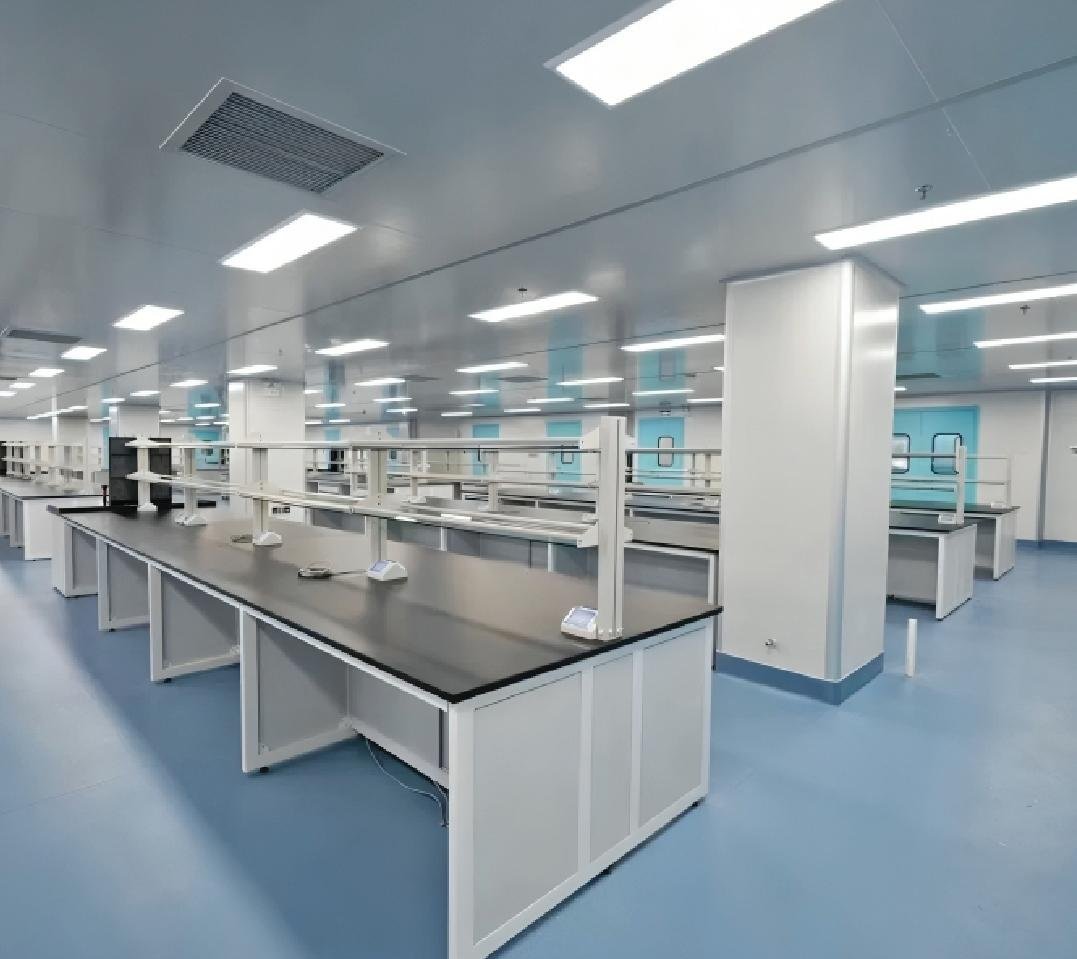
clean room setup in kerala
Industries That Rely on Cleanrooms
Cleanrooms are foundational infrastructure across a wide range of industries:
Pharmaceuticals and Biotechnology
– Sterile drug manufacturing, vaccine production, and cell/genetherapy development require strict contamination control to ensure product safety and regulatorycompliance (e.g., FDA, EMA, GMP standards).
Semiconductor and Electronics Manufacturing
– Microchips are manufactured at nanometer scales,where a single dust particle can destroy an entire wafer.
Medical Device Manufacturing
– Implants, surgical instruments, and diagnostic devices must beproduced in contamination-free environments to ensure patient safety.
Aerospace and Defense
– Precision components, satellite assembly, and optics manufacturing demandparticle-free conditions to guarantee reliability.
Hospitals and Healthcare
– Operating rooms and isolation units use cleanroom principles to reduceinfection risk during surgery and patient care.
Research Laboratories
– Nanotechnology, materials science, and biological research often requirecontrolled environments to maintain experimental accuracy.
Food and Cosmetics Production
– Certain high-purity food and cosmetic products are manufacturedunder cleanroom conditions to meet safety and quality standards.
Benefits of Cleanroom Environments
Implementing a cleanroom offers several critical advantages:
Product Integrity
– Minimizes the risk of contamination that could compromise product safety,performance, or shelf life.
Regulatory Compliance
– Helps organizations meet strict industry regulations and quality certifications(ISO, GMP, FDA).
Improved Yield
– In manufacturing environments like semiconductors, reduced contamination directlytranslates into higher production yields and lower waste.
Worker and Patient Safety
– In medical and biotech contexts, cleanrooms protect both the peopleproducing the product and the end users who rely on it.
Data and Research Accuracy
– In scientific settings, a controlled environment ensures experimentalresults aren't skewed by external contamination.
Designing and Maintaining a Cleanroom
Building an effective cleanroom involves careful planning across several dimensions:
Defining the Required Classification
– Based on the product or process, engineers determine thenecessary ISO class and corresponding air change rates.
Facility Layout
– Cleanrooms are often designed with graduated zones, moving from less clean "gowning"areas to the most controlled core production zones.